ShopMy Comparative Study
February 2026
On first glance, ShopMy markets itself as luxury. Its top-of-funnel presentation earns that impression, spotlighting curators like Sofia Richie Grainge and brands like Prada.
But ShopMy’s premium posture appears strongest at top-of-funnel signalling, and the underlying data suggest not one, but four gaps remain underserved:
People
Luxury
Mid-mass skew, luxury underserved
Menswear
Female-skew, menswear near zero
Product
Craft
Design and usability inconsistencies
Peformance
Speed + stability below benchmarks
People Gap (1)
Luxury
In December, ShopMy shared it's 'six best-selling brands' with Business Insider (from its end-of-year report). Yet only 1/6 appear in ShopMy’s own 72 'featured brands' list (via landing page) which skew more premium (i.e. Prada, Gucci). That mismatch is fairly trivial, but the rabbit hole goes deeper.
Data Analysis: To test what segment ShopMy actually serves, I ran a comparison using its own public data. ShopMy shopping categories can be sorted by “Most Popular,” ranked by how often each item is shared by curators.
I took the top 200 items across three luxury representative categories: Tops, Jeans, and Blazers, weighted each by mention frequency (~100,000 mentions/category), then tested measures of central tendency.
I repeated this experiment at retailer Ssense to serve as a luxury benchmark. (Note: Minor variance may occur).
ShopMy
~$65
Tops
~$121
Jeans
~$200
Blazers
Ssense
~$326
Tops
~$600
Jeans
~$1,274
Blzers
Result: SSENSE is approximately 5-6× more expensive at the median.
And it's not just price, amongst the top 10 most mentioned brands of each category (26 unique brands total):
SSENSE only stocks ~35%
Only 2 appear in ShopMy’s 72 “featured brands”
Only 1 appears in ShopMy’s 6 “best-selling brands”
By this proxy, ShopMy's most-surfaced inventory actually skews mass-mid market, and the luxury segment remains underserved.
This is because one platform can’t credibly serve both masters simultaneously (can't buy Gucci at Amazon; same principle applies). Most top-tier creators avoid mid-market platforms because the association dilutes their personal brand… we will serve them.
People Gap (2)
Menswear
ShopMy’s biggest blind spot isn’t luxury, it’s menswear. A telling signal: the top result when searching “Mens” is “Menstrual Cups.”
The few listings that do exist are overwhelmingly curated by women, with near-zero male participation.
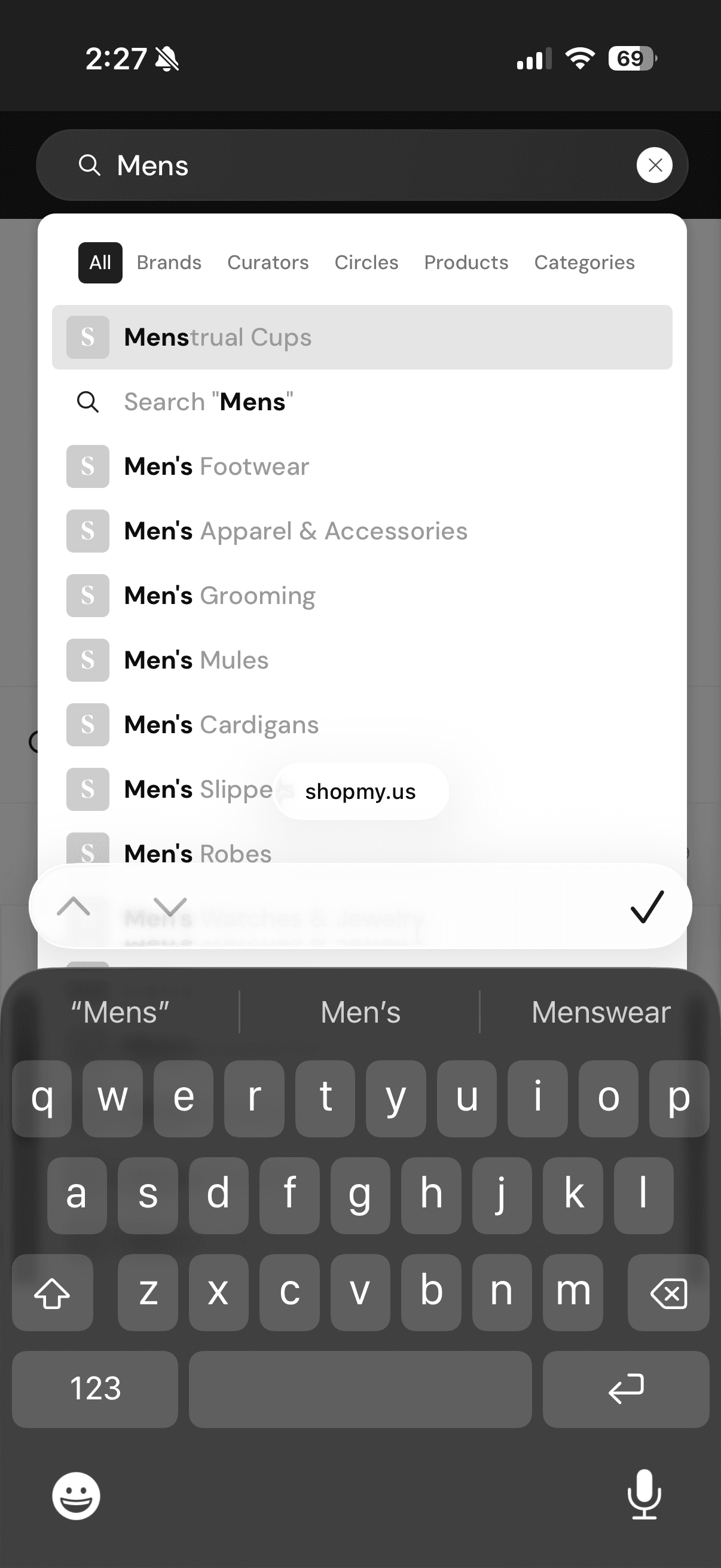
This tracks with mass-market dynamics, where a lingering stigma around the feminisation of fashion discourages male participation, something LTK or ShopMy, with heavy female participation, struggle to correct.
Unlike incumbents, our target creator list is 66:34 women-to-men, far closer to the market's 63:37 (Euromonitor).
Upmarket, the stigma also fades (participating men skew luxury). So we'll address this two-fold:
Structurally (high male presence from day one + androgynous branding)
Segment (luxury carries less stigma)
The prize: menswear is 37% of the market and growing ~10% faster than womenswear (Euromonitor).
Product Gap (1)
Craft
ShopMy and LTK’s website isn’t merely a channel to sell products; it is the product. This makes its design and performance critically important.
A brief exploratory audit surfaced these following inconsistencies, observed at the time of review:
Alignment and Spacing Inconsistencies:
Product Gap (2)
Peformance
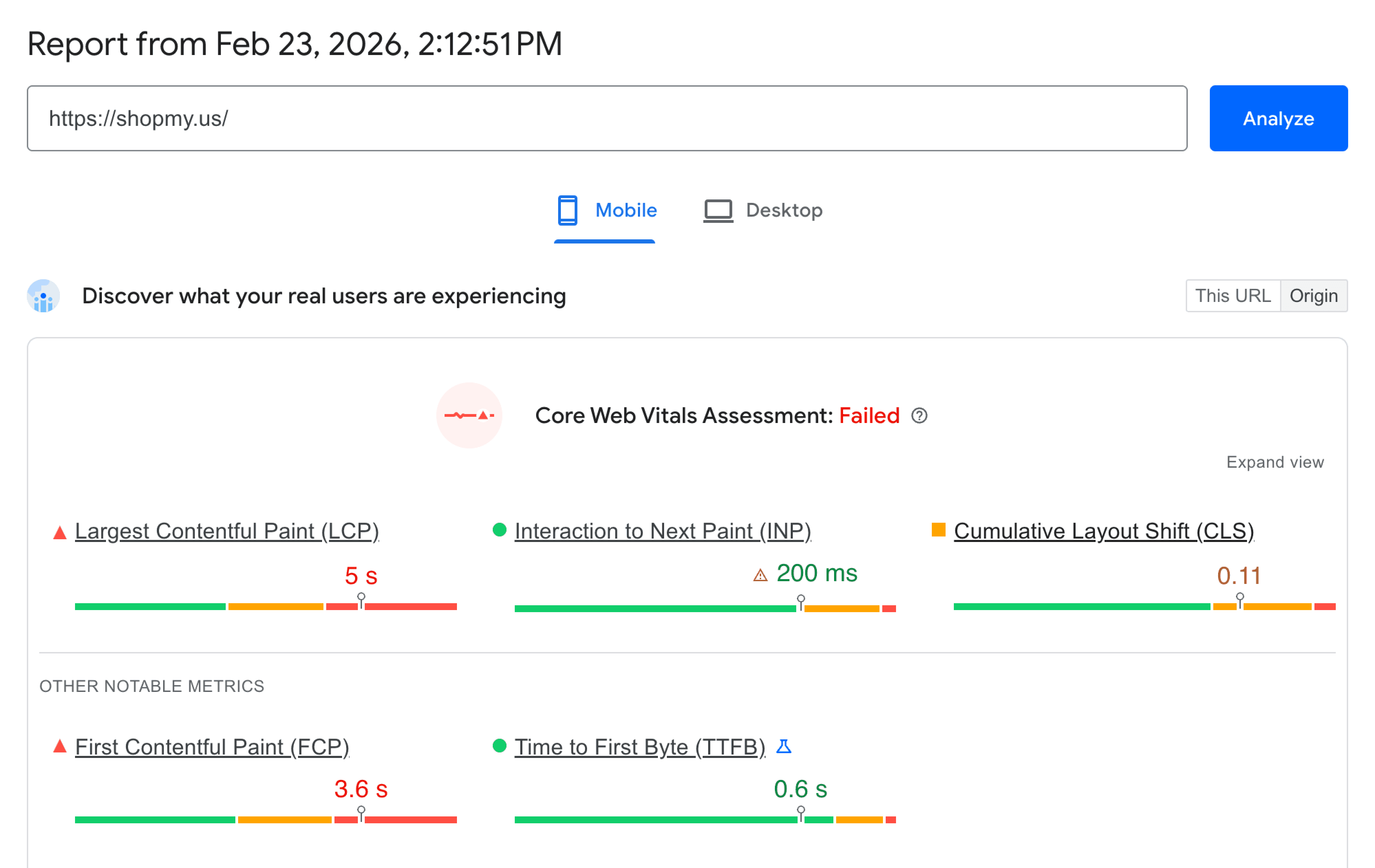
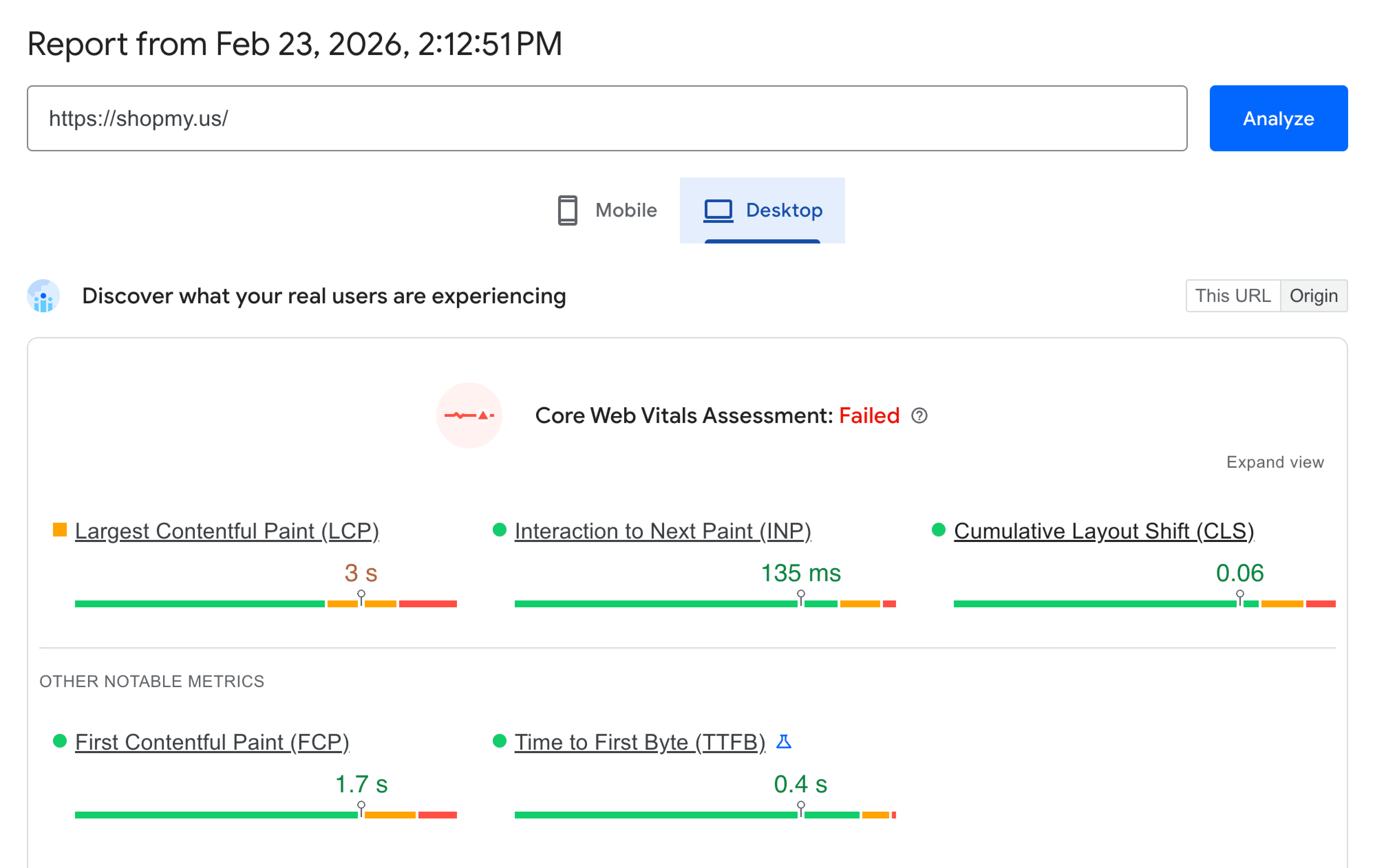
Chrome UX Report shows ShopMy underperforming benchmarks.
ShopMy Performance
Ssense Performance
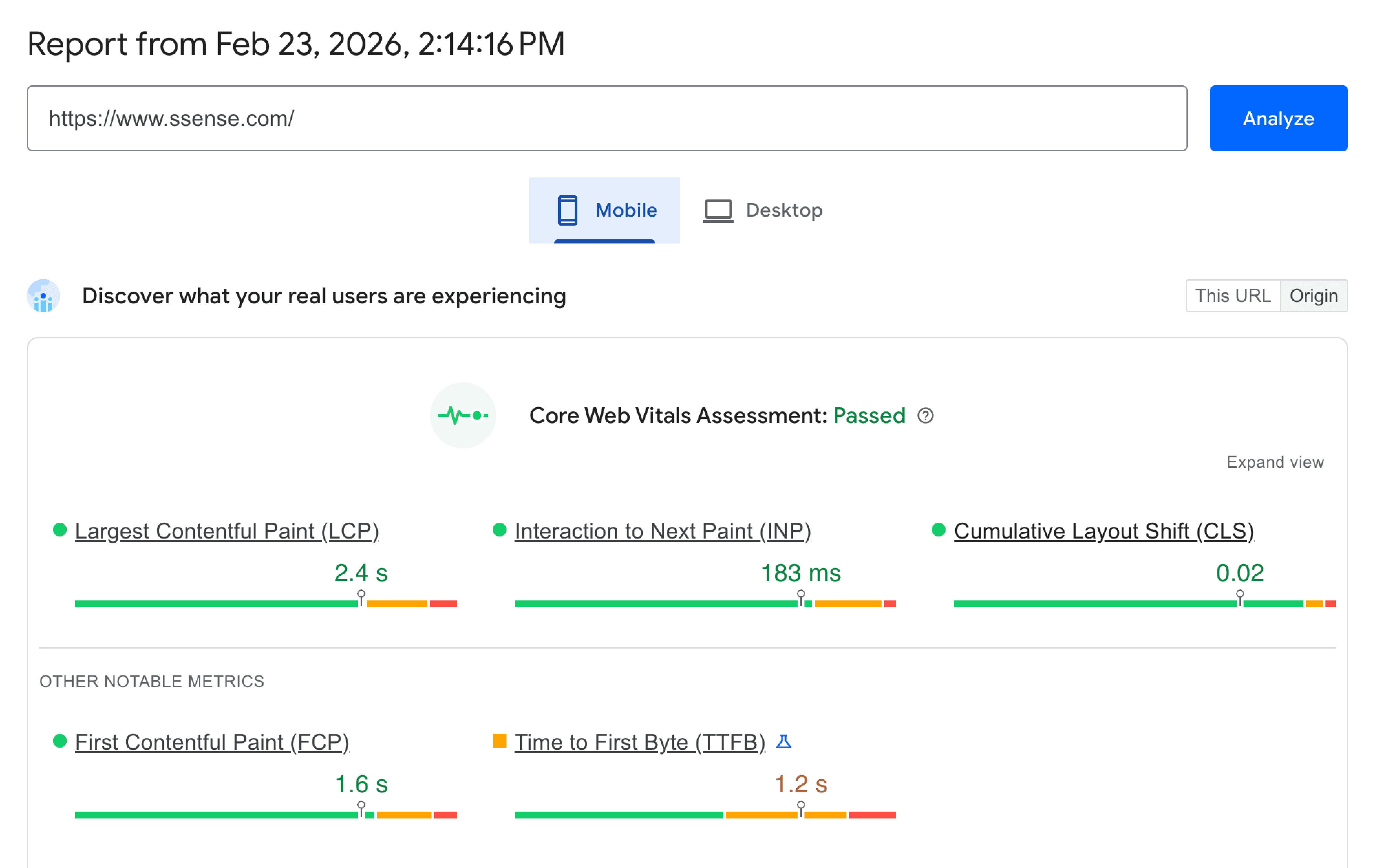
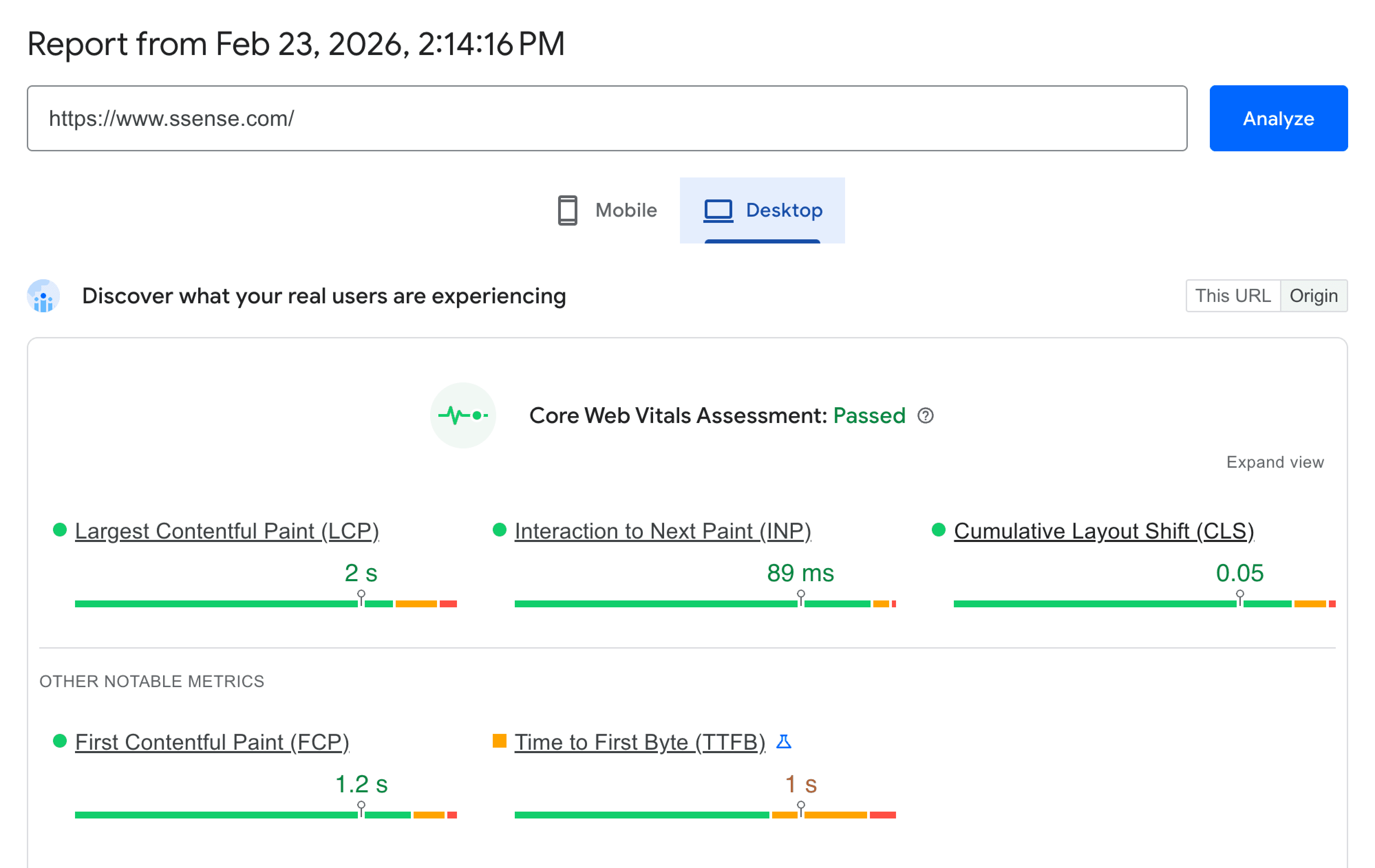
Result: ShopMy is ~1.7× as slow (LCP) and ~2.4× as unstable (CLS) as Ssense, despite comparable image density.
Conclusion
What does this mean?
ShopMy’s luxury positioning is smart marketing: even non-luxury shoppers like to feel they’re buying upmarket. But available data suggests a different underlying reality:
People: Mid-market skew that leaves luxury underserved
People: Heavy womenswear skew that leaves menswear unaddressed
Product: "Failed" performance (via Chrome)
Product: Design short of expectation
Good enough is good enough until it's not.
Most startups rely on one gap in a market. We have four.
Likely: the market is underbuilt. As of 2025, there are 1,639 unicorns worldwide. For founders, the best hunting grounds tend to be markets with 1-4 unicorns: one to validate demand, fewer than three to avoid stiff competition. Sampling startups within this golden interval:
Tech Sectors with Few Unicorns (but ≥1)
De-extinction (1)
Colossal Biosciences
Brain Computer Interfaces (2)
Neuralink, MindMaze
Fusion Energy (3)
Commonwealth Fusion, TAE Technologies, Helion Engergy
Quantum Computing (4)
Quantinuum, PsiQuantum, SandboxAQ, Xanadu
AR/VR/MR (3)
Mihoyo, Animoca Brands, Naver Z
Prediction Markets (2)
Kalshi, Polymarket
Hydrogen Economy (3)
Electric Hydrogen, Monolith, H2 Green Steel
Nuclear Fission (4)
NuScale, Kairos Power, TerraPower, Radiant
Resale Marketplaces (3)
StockX, Goat Group, Vestiaire Collective
Influencer Marketing (2)
LTK, ShopMy
Mammoths, Neurons, Fusion, Qubits, Influencer.
Notice an imposter? Seven are pre-commercial deep-tech frontiers: capital intensive, regulated, and decades from revenue. Then, like a sore thumb: Influencer Marketing and Resale, profitable and free of the deep-tech baggage.
So, what's the catch? Is value pooled around two lock-in incumbents? Considering ShopMy only minted unicorn status five months ago, likely not. ShopMy themselves wrote in their 2024 pitch deck: “There isn’t a winner in the space. None of the exisitng platforms sufficiently serve as a technical backbone for this movement.”